Leaving an Inheritance to a Child With a Disability Without Putting Benefits at Risk

A grandparent wants to leave something behind for a grandchild with a disability. It comes from love, and it seems simple: write the child into the will, done.

But a direct inheritance can do the opposite of what was intended. Many adults with a disability rely on monthly income support from their province. Those programs are usually income and asset tested, meaning there is a limit on how much money or property a person can hold at once. A lump sum that arrives all at once, even a generous one, can push someone over that limit and pause the support they depend on.

The good news is that families have real tools to leave money behind without creating that risk. Here is how the pieces fit together.

When a Direct Inheritance Causes a Problem

Provincial disability programs each set their own asset limits. In Ontario, for example, a single person on the Ontario Disability Support Program can generally hold up to $40,000 in assets before it affects their support. An inheritance that lands directly in a person’s own name and bank account counts toward that limit the same way any other savings would.

Rules and dollar limits differ from province to province, and they change over time, so contacting the provincial program directly is the most reliable way to confirm current numbers. The bigger point holds everywhere: this is not a reason to leave a family member out of a will. It is a reason to think carefully about how the gift arrives, not just how much of it there is.

The RDSP Is Often the Best First Stop

If the family member already has a Registered Disability Savings Plan, that is usually the first place to look. RDSP savings and RDSP withdrawals are generally excluded when provinces calculate disability benefit eligibility, and they do not count against federal income-tested benefits either.

The RDSP has a lifetime contribution limit of $200,000, with no annual cap, so a large gift can often be deposited directly into the plan.

There is a timing detail worth knowing. The government matches personal contributions with grants, up to $3,500 a year and $70,000 over a lifetime, but grants are only paid on contributions made by December 31 of the year the beneficiary turns 49. A single lump sum deposit only attracts grant money for that one year, plus any unused entitlement carried forward from past years, capped at $10,500 in grant for that one year. Spreading a large gift across several years, rather than depositing it all at once, is usually the better way to capture more of the matching money available over time. These federal dollar limits can change over time, so it’s worth confirming the current numbers before acting on them.

What a Discretionary Trust Actually Does

Sometimes the amount involved is larger than the RDSP can hold, or the person has already reached the RDSP contribution limit. This is where a discretionary trust, often called a Henson trust, comes in.

A discretionary trust holds money on someone’s behalf without giving that person a legal right to demand it. A trustee, often a parent, sibling, or professional, decides when and how the money is used. Because the person the trust is for cannot force a payment, the money is generally not counted as their personal asset for provincial disability benefit purposes.

This kind of trust needs very specific legal wording to work as intended, usually written into a will. How these trusts are treated can differ from province to province, so what protects benefits in one place may need adjusting in another. Quebec’s civil law system does not use this kind of common law trust the same way, so families there typically rely on different legal tools to reach the same goal.

The Beneficiary Designation Trap

Wills are not the only place this problem shows up. Life insurance policies, RRSPs, and other registered accounts let the owner name a beneficiary directly, and it is common to simply write in the name of the family member with a disability.

That creates the exact same issue as a direct inheritance. The moment the policy pays out, the money belongs to that person outright, with no trustee involved. Families often name the RDSP or a trust as the beneficiary instead, so the money is managed rather than handed over all at once.

It is worth checking every policy and account, not just the will. A carefully built estate plan can still be undone by a single beneficiary form filled out years earlier and forgotten.

Bringing the Rest of the Family Into the Plan

A parent can build all of this carefully and still see it unravel if a grandparent, aunt, or uncle leaves money directly to the same family member in their own separate will.

Sharing the plan with extended family, in plain terms, helps avoid that outcome. It does not have to be a difficult conversation. It can be as simple as explaining that gifts are welcome, and that directing them to the trust or the RDSP, rather than straight to the person, actually protects more of the gift over the long run.

A little planning ahead of time turns a well-meant inheritance into lasting support instead of an accidental setback. The RDSP, a properly built trust, and a quick check of every beneficiary form are the three places most families find real peace of mind.

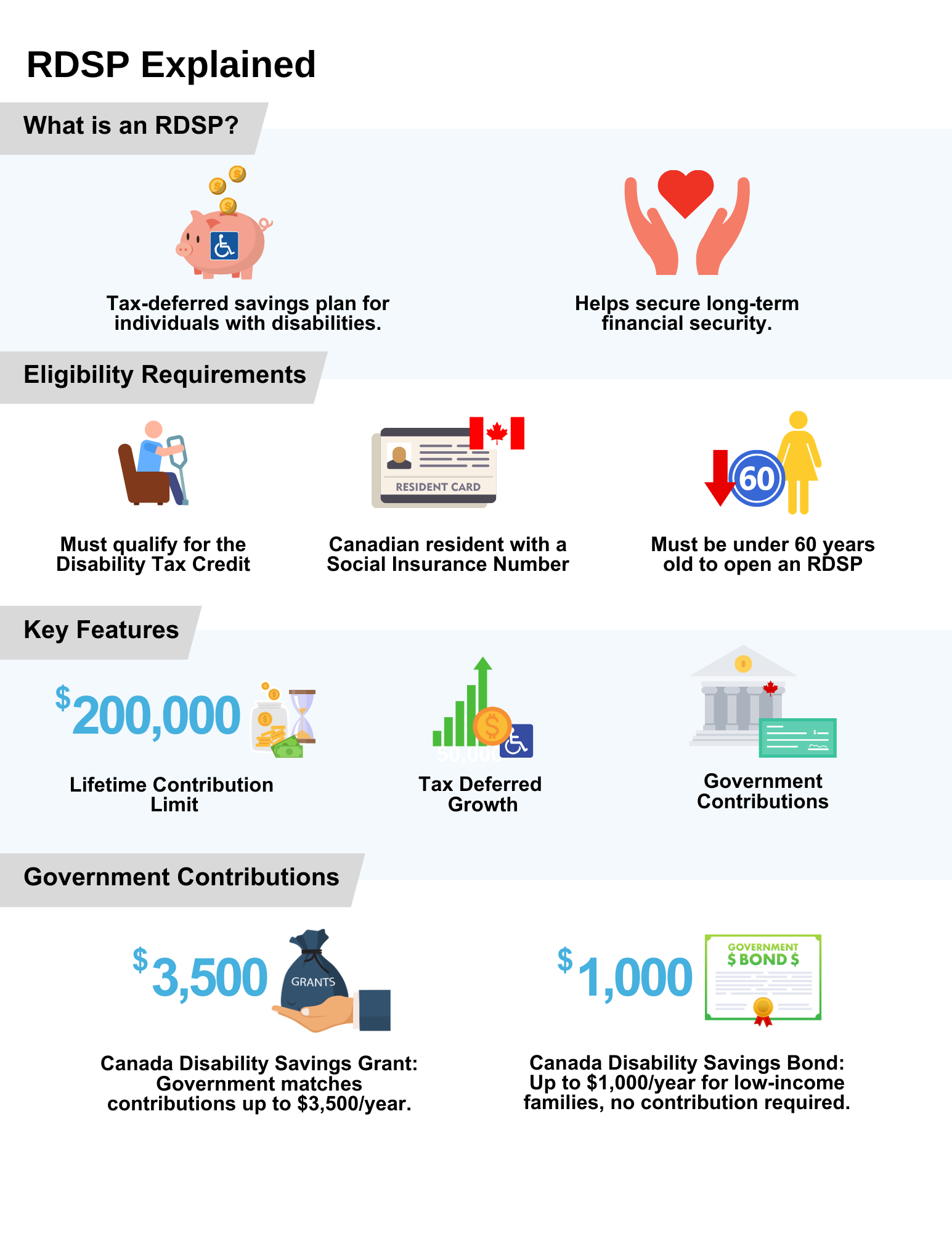
RDSP Explained 2026

brandableContent

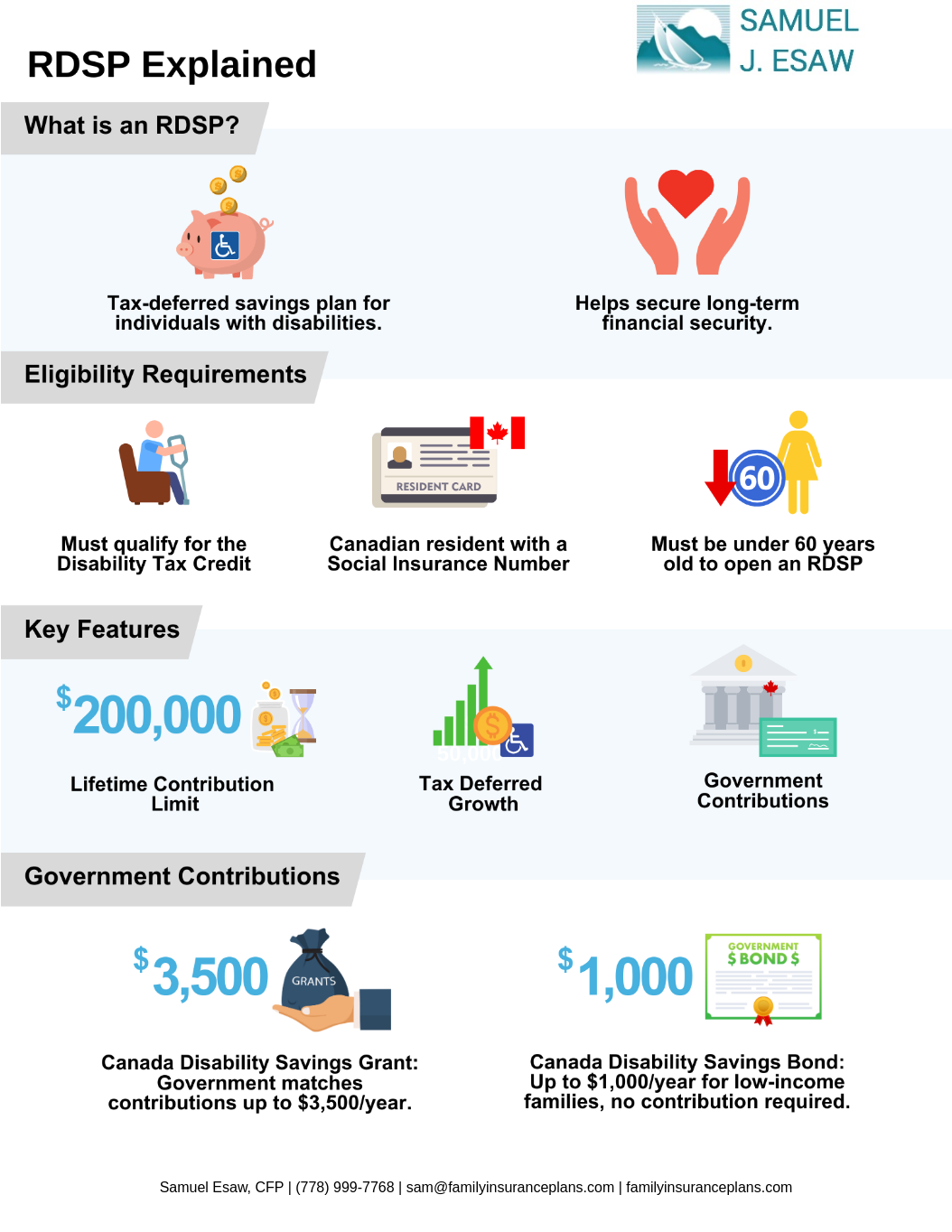
Registered Disability Savings Plan (RDSP) Explained

Planning for the long-term financial security of individuals with disabilities is a priority for many families. The Registered Disability Savings Plan (RDSP) is one of the most powerful savings tools available in Canada, offering tax-deferred growth and generous government contributions to help build financial security over time.

If you or a loved one qualifies for the Disability Tax Credit (DTC), the RDSP can play a key role in creating a long-term financial cushion for future needs.

What is the RDSP?

The RDSP is a savings plan designed to help individuals with disabilities save for their long-term financial security. It is a tax-deferred account, which means the investments grow tax-free while inside the plan, though taxes may apply upon withdrawal. The RDSP offers government assistance through the Canada Disability Savings Grant and the Canada Disability Savings Bond, significantly boosting savings for those who qualify.

Key Features of RDSP

  • Tax-Deferred Growth- Investments grow without annual taxation while inside the plan.

  • Government Contributions- Eligible beneficiaries may receive grants and bonds from the federal government.

  • Flexible Contributions- Contributions can be made by the beneficiary, parents, family members, or friends.

  • Lifetime Contribution Limit- Up to $200,000 in personal contributions, with no annual contribution limit.

Eligibility Criteria for RDSP

To be eligible for the RDSP, the beneficiary must:

  • Qualify for the Disability Tax Credit (DTC)

  • Be a Canadian resident with a valid Social Insurance Number (SIN)

  • Be under age 60 when the plan is opened

  • Receive government grants and bonds only until the end of the year they turn 49

Government Contributions Explained

Canada Disability Savings Grant (CDSG): The government will match contributions up to 300%, 200%, or 100%, depending on the beneficiary’s family income and the contributions made.

The CDSG provides matching government contributions based on family income, which is indexed annually.

  • Lower- and modest-income families may receive matching grants of up to 300% on contributions

  • Higher-income families may receive a 100% match on eligible contributions

  • Maximum annual grant: $3,500

  • Lifetime grant maximum: $70,000

Even small annual contributions can result in substantial government support over time.

Canada Disability Savings Bond (CDSB):

The CDSB is designed to support individuals with lower family income and does not require personal contributions.

  • Eligible beneficiaries may receive up to $1,000 per year

  • Bond amounts are determined on a sliding scale based on family income

  • Lifetime bond maximum: $20,000

Why Open an RDSP?

The RDSP is one of the most effective ways to save for individuals with disabilities, providing them with long-term financial security. By taking advantage of tax-deferred growth and government contributions, families can ensure that their loved ones have financial support when they need it most.

The RDSP is one of the most powerful and underutilized savings tools in Canada for families and individuals living with disabilities. It offers:

  • Long-term financial growth

  • Tax advantages

  • Up to $90,000 in government contributions

  • Financial security for adulthood and retirement

By contributing early and consistently, even modest contributions can lead to substantial growth thanks to government support and tax-deferred compounding.

Contact us today. 

Sources: . “Registered Disability Savings Plan (RDSP).” Canada Revenue Agency: https://www.canada.ca/en/revenue-agency/services/tax/individuals/topics/registered-disability-savings-plan-rdsp.html

“Canada Disability Savings Grant and Bond.” Government of Canada: https://www.canada.ca/en/revenue-agency/services/tax/individuals/topics/registered-disability-savings-plan-rdsp/canada-disability-savings-grant-canada-disability-savings-bond.html

What Is Life Insurance and How Does It Work?

What Is Life Insurance and How Does It Work?

Have you ever wondered what would happen to your family’s finances if you were no longer here? It’s not an easy thought. But it is an important one. Life insurance is designed to protect the people you care about most if something unexpected happens.

Many people avoid this topic because it feels uncomfortable or confusing. The good news is that life insurance is actually quite simple once you break it down.

What Is Life Insurance?

Life insurance is a contract between you and an insurance company. You pay a regular payment called a premium. In return, the insurance company agrees to pay a lump sum of money to someone you choose (your beneficiary) if you pass away.

That lump sum is called a death benefit. In most cases, it is paid tax-free to your beneficiary.

Think of life insurance like a safety net. You hope it is never needed. But if it is, it can help your family stay financially stable during a very difficult time.

Millions of Canadians have some form of life insurance coverage. For many families, it plays an important role in protecting income and covering large expenses.

How Does Life Insurance Work?

The process is straightforward.

First, you apply for coverage. The insurance company reviews details such as your age, health, lifestyle, and sometimes your occupation. This helps them decide your premium and whether you qualify.

Once approved, you begin paying premiums. As long as you keep paying, your coverage remains active.

If you pass away while the policy is active, your beneficiary files a claim. The insurance company reviews the claim and then pays out the death benefit.

Your beneficiary can use the money for any purpose, such as:

  • Paying off a mortgage

  • Covering funeral expenses

  • Replacing lost income

  • Paying off debt

  • Supporting children’s education

The goal is to reduce financial stress at a time when your family is already dealing with emotional loss.

The Two Main Types of Life Insurance

Most people choose between two main types of coverage: term life insurance and permanent life insurance.

Term Life Insurance

Term life insurance covers you for a set period of time, such as 10, 20, or 30 years.

It is usually the most affordable option, especially for young families. If you pass away during the term, the policy pays out. If the term ends and you are still living, the coverage ends unless you renew it.

Term insurance works well for temporary needs. For example:

  • Protecting your income while your children are young

  • Covering a mortgage while the balance is high

  • Replacing income during your working years

It is simple and focused on protection.

Permanent Life Insurance

Permanent life insurance covers you for your entire lifetime, as long as premiums are paid.

It also includes a savings feature called cash value. Over time, this value can grow on a tax-deferred basis.

Permanent coverage is usually more expensive than term coverage. However, it can support longer-term goals such as:

  • Covering final expenses

  • Leaving money to family or a charity

  • Helping manage taxes at death

  • Supporting estate planning goals

The right type of coverage depends on your needs, timeline, and budget.

How Much Coverage Do You Need?

This is one of the most common questions people ask.

A good starting point is to ask: If I were gone tomorrow, what financial gap would my family face?

You may want to consider:

  • Your mortgage balance

  • Other debts

  • Ongoing living expenses

  • Childcare costs

  • Future education expenses

  • Final expenses

Some people use a simple guideline like 10 times their annual income. But that is only a starting point. Your personal situation matters more than any rule of thumb.

For example, someone with no dependents and little debt may need very little coverage. A household with young children and a large mortgage may need much more.

The goal is to match coverage with real responsibilities.

Is Life Insurance Expensive?

Many people assume life insurance costs more than it does. In reality, term coverage can be very affordable, especially if you are young and in good health.

Your premium is based on factors such as:

  • Age

  • Health history

  • Smoking status

  • Coverage amount

  • Type of policy

The younger and healthier you are when you apply, the lower your premium is likely to be.

Waiting can increase the cost. Health can change over time. Securing coverage earlier can help lock in lower rates.

Who Should Consider Life Insurance?

Life insurance is not necessary for everyone. But it is important for many people.

You may want to consider coverage if:

  • Someone depends on your income

  • You share debts with a partner

  • You have children

  • You own a home

  • You want to leave money behind for loved ones

Even stay-at-home parents may need coverage. If they were not there, the cost of childcare and household support could be significant.

In Canada, life insurance benefits are generally paid tax-free to beneficiaries. This helps ensure that the full amount can be used for its intended purpose.

Final Thoughts

Life insurance is a practical tool. It helps protect the people you care about from financial hardship if something unexpected happens. It can provide stability, cover major expenses, and support your family’s future.

If you are unsure whether you need coverage, start by reviewing who depends on you and what financial responsibilities you carry. A short conversation can bring clarity and peace of mind.

If you would like to explore how life insurance fits into your overall strategy, I would be happy to guide you through the options and help you make an informed decision.

This is for informational purposes only and does not constitute financial, legal, or tax advice. Always consult a qualified professional regarding your specific situation. We are not responsible for any actions taken based on this content.

2025 Federal Budget Highlights

2025 Federal Budget Highlights

On November 4, 2025, the budget was delivered by the Honourable François-Philippe Champagne, Minister of Finance and National Revenue.

The 2025 Federal Budget focuses on stability, simplicity, and long-term growth. There are no broad tax increases or major new spending programs. Instead, the government is emphasizing restraint, modernization, and productivity.

For individuals and business owners, the goal is clear: help Canadians access benefits more easily, encourage investment in innovation and clean energy, and update trust and estate rules to maintain fairness across the system.

Economic Overview

Canada’s federal deficit is projected at $78.3 billion for 2025–26. The government aims to stabilize the debt-to-GDP ratio while maintaining funding for priorities such as housing, defence, and clean energy.

Spending will focus on programs that improve productivity, while efficiency reviews across departments are expected to reduce overlap and administrative costs. This marks a shift toward sustainable fiscal management and practical, targeted investments.

Personal and Family Tax Measures

Several measures are designed to make life more affordable, particularly for first-time home buyers, caregivers, and lower-income households.

Eliminating the GST for First-Time Home Buyers

First-time home buyers will not pay the 5 percent federal GST on new homes priced up to $1 million. For new homes between $1 million and $1.5 million, a partial GST reduction applies. This change provides meaningful savings and makes new construction more accessible for Canadians entering the housing market.

Home Accessibility Tax Credit

Starting in 2026, expenses can no longer be claimed under both the Home Accessibility Tax Credit and the Medical Expense Tax Credit. The rule prevents duplicate claims but continues to support renovations that make homes safer and more accessible for seniors or individuals with disabilities.

Top-Up Tax Credit

To balance the reduction in the lowest federal tax bracket—from 15 percent to 14.5 percent in 2025, and 14 percent in 2026—the government introduced a Top-Up Tax Credit to preserve the value of non-refundable credits such as tuition, medical, and charitable amounts. This temporary measure, available from 2025 through 2030, ensures Canadians receive the same credit value even as rates decrease.

Personal Support Workers (PSW) Tax Credit

A new refundable tax credit equal to 5 percent of eligible income, up to $1,100 per year, will be available for certified personal support workers beginning in 2026. The measure acknowledges the importance of care professionals and provides direct relief to those in long-term and community-care roles.

Automatic Federal Benefits

Starting in 2025, the Canada Revenue Agency will begin automatically filing simple tax returns for eligible Canadians who do not normally file. This will allow low-income earners and seniors to receive benefits such as the Canada Workers Benefit, GST/HST Credit, and Canada Carbon Rebate automatically. Those with more complex financial situations will continue to file regular returns.

Registered Plans, Trusts, and Estate Planning

The budget introduces several changes affecting trusts and registered plans—key tools in long-term financial and estate planning.

Bare Trust Reporting Rules

Implementation of new bare trust reporting requirements has been delayed. The rules will now apply to taxation years ending December 31, 2026, or later. This postponement gives individuals, trustees, and professionals more time to prepare for the new filing obligations.

The 21-Year Rule for Trusts

Trusts—particularly most personal or family trusts—are generally considered to have sold and repurchased their capital property every 21 years (a “deemed disposition”). This rule prevents indefinite deferral of capital-gains tax on assets that grow in value.

When property is moved on a tax-deferred basis from one trust to another, the receiving trust normally inherits the original 21-year anniversary date so that tax timing does not reset.

Some estate-planning arrangements have transferred trust property indirectly—for example, through a corporation or a beneficiary connected to a second trust—so that the transfer did not appear to be trust-to-trust. These arrangements effectively extended the period before capital gains would be recognized.

Budget 2025 broadens the anti-avoidance rule to include indirect transfers. Any transfer of property made on or after November 4, 2025, that effectively moves assets from one trust to another will retain the original 21-year schedule.

For families that use trusts in estate or business-succession planning, this change reinforces the importance of reviewing structure and timing. Trusts remain valuable for asset protection, legacy planning, and income distribution—this update simply ensures consistent application of the 21-year rule.

Qualified Investments for Registered Plans

Beginning January 1, 2027, all registered plans—RRSPs, TFSAs, FHSAs, RDSPs, and RESPs—will follow a single harmonized list of qualified investments. Small-business shares will no longer qualify for new contributions, though existing holdings will remain grandfathered. The update simplifies compliance and clarifies which assets can be held in registered accounts.

Business and Investment Incentives

For business owners, Budget 2025 provides opportunities to reinvest, innovate, and modernize operations, with emphasis on manufacturing, research, and clean technology.

Immediate Expensing for Manufacturing and Processing Buildings

Businesses can now claim a 100 percent deduction for eligible manufacturing and processing buildings acquired after Budget Day and available for use before 2030. This full write-off improves cash flow and encourages earlier expansion. The benefit will gradually phase out after 2033.

Scientific Research and Experimental Development (SR&ED)

The refundable SR&ED tax credit limit has increased from $3 million to $6 million per year, effective for taxation years beginning after December 16, 2024. This expansion strengthens support for small and medium-sized Canadian businesses investing in innovation and technology.

Tax Deferral Through Tiered Corporate Structures

To prevent deferrals of tax on investment income, new rules will suspend dividend refunds for affiliated corporations with mismatched fiscal year-ends. This ensures consistent taxation within corporate groups and aligns refund timing with income recognition.

Agricultural Co-operatives

The tax deferral for patronage dividends paid in shares has been extended to December 31, 2030, continuing to support agricultural co-operatives and their members.

Clean Technology and Clean Electricity Investment Credits

Clean-technology and clean-electricity incentives have been expanded to include additional critical minerals—such as antimony, gallium, germanium, indium, and scandium—used in advanced manufacturing and renewable energy production. The Canada Growth Fund can now invest in qualifying projects without reducing the amount of credit companies can claim, keeping the incentive structure attractive for green investment.

Canadian Entrepreneurs’ Incentive

The government has confirmed it will not proceed with the previously proposed Canadian Entrepreneurs’ Incentive. The existing Lifetime Capital Gains Exemption remains unchanged and continues to apply to the sale of qualified small-business shares.

Tax Simplification and Repealed Measures

To simplify administration and reduce complexity, two taxes are being repealed:

– Underused Housing Tax, beginning in 2025

– Luxury Tax on aircraft and vessels for purchases made after November 4, 2025

In addition, the Canada Carbon Rebate will issue its final household payment in April 2025, with no rebates available for returns filed after October 30, 2026. These changes are meant to streamline compliance and eliminate programs that were costly to administer.

Government Direction and Spending Priorities

Beyond taxation, the budget sets out the government’s broader policy priorities.

Downsizing Government: A comprehensive efficiency review is underway to eliminate duplication across departments and generate long-term savings.

Cuts to Immigration: To ease pressure on housing and infrastructure, temporary-resident levels will be reduced by about 20 percent over two years, while maintaining pathways for essential workers.

Defence Spending: Canada will invest an additional $7 billion over five years to strengthen NATO participation, Arctic defence, and cybersecurity. By 2030, defence spending is expected to reach 1.8 percent of GDP.

Oil and Gas Emission Cap: A phased-in cap starting in 2026 will allow companies to meet targets through carbon-capture and clean-tech investments rather than penalties.

Final Thoughts

For individuals, the most relevant updates include GST relief for first-time home buyers, improved benefit access, and continued tax relief for caregivers and support workers. For business owners, the focus remains on productivity—through immediate expensing, expanded SR&ED credits, and clean-tech investment incentives. For families using trusts or inter-generational structures, the clarified 21-year rule reinforces transparency in estate planning.

If you’d like to review what these changes mean for you or your business, please get in touch. We can look at your goals and make sure you’re well prepared for the year ahead.

RDSP Explained

brandableContent

Registered Disability Savings Plan (RDSP) Explained

Planning for the future financial security of individuals with disabilities is a priority for many families. The Registered Disability Savings Plan (RDSP) is a valuable tool that offers long-term financial security through tax-deferred savings and government contributions. If you or a loved one qualifies for the Disability Tax Credit (DTC), the RDSP can help build a financial cushion for future needs.

What is the RDSP?

The RDSP is a savings plan designed to help individuals with disabilities save for their long-term financial security. It is a tax-deferred account, which means the investments grow tax-free while inside the plan, though taxes may apply upon withdrawal. The RDSP offers government assistance through the Canada Disability Savings Grant and the Canada Disability Savings Bond, significantly boosting savings for those who qualify.

Key Features of RDSP

– Tax-Deferred Growth: Investments grow without being taxed until withdrawn.

– Government Contributions: Depending on family income, the Canadian government may contribute through matching grants and bonds.

– Flexibility: Contributions can be made by the beneficiary, family, or friends.

– Lifetime Contribution Limit: Up to $200,000 in contributions, with no annual limit.

Eligibility Criteria for RDSP

To be eligible for the RDSP, the beneficiary must:

– Qualify for the Disability Tax Credit (DTC).

– Be a Canadian resident with a valid Social Insurance Number (SIN).

– Be under the age of 60 when the account is opened (contributions cease at 49 years old).

Government Contributions Explained

Canada Disability Savings Grant (CDSG): The government will match contributions up to 300%, 200%, or 100%, depending on the beneficiary’s family income and the contributions made.

For 2023, the income thresholds and matching rates are as follows:

– Family income of $106,717 or less:

   • 300% match on the first $500 contributed, giving up to $1,500 in grants.

   • 200% match on the next $1,000 contributed, giving up to $2,000 in grants.

– Family income over $106,717:

   • 100% match on the first $1,000 contributed, giving up to $1,000 in grants.

The maximum annual CDSG a beneficiary can receive is $3,500, and the lifetime maximum is $70,000. This grant is a powerful tool for enhancing your savings, as the government significantly boosts even modest contributions to the RDSP.

Canada Disability Savings Bond (CDSB) for 2023: The CDSB is available to low-income Canadians to help grow their RDSP even if they are unable to make regular contributions. 

For 2023, if the beneficiary’s family income is $37,908 or less, the government will contribute up to $1,000 annually to the RDSP without requiring any personal contributions.

– Families with incomes between $37,908 and $56,756 may receive a partial bond based on a sliding scale.

– The maximum lifetime CDSB contribution is $20,000.

Why Open an RDSP?

The RDSP is one of the most effective ways to save for individuals with disabilities, providing them with long-term financial security. By taking advantage of tax-deferred growth and government contributions, families can ensure that their loved ones have financial support when they need it most.

Contact us today. 

Understanding the Registered Education Savings Plan (RESP)

brandableContent

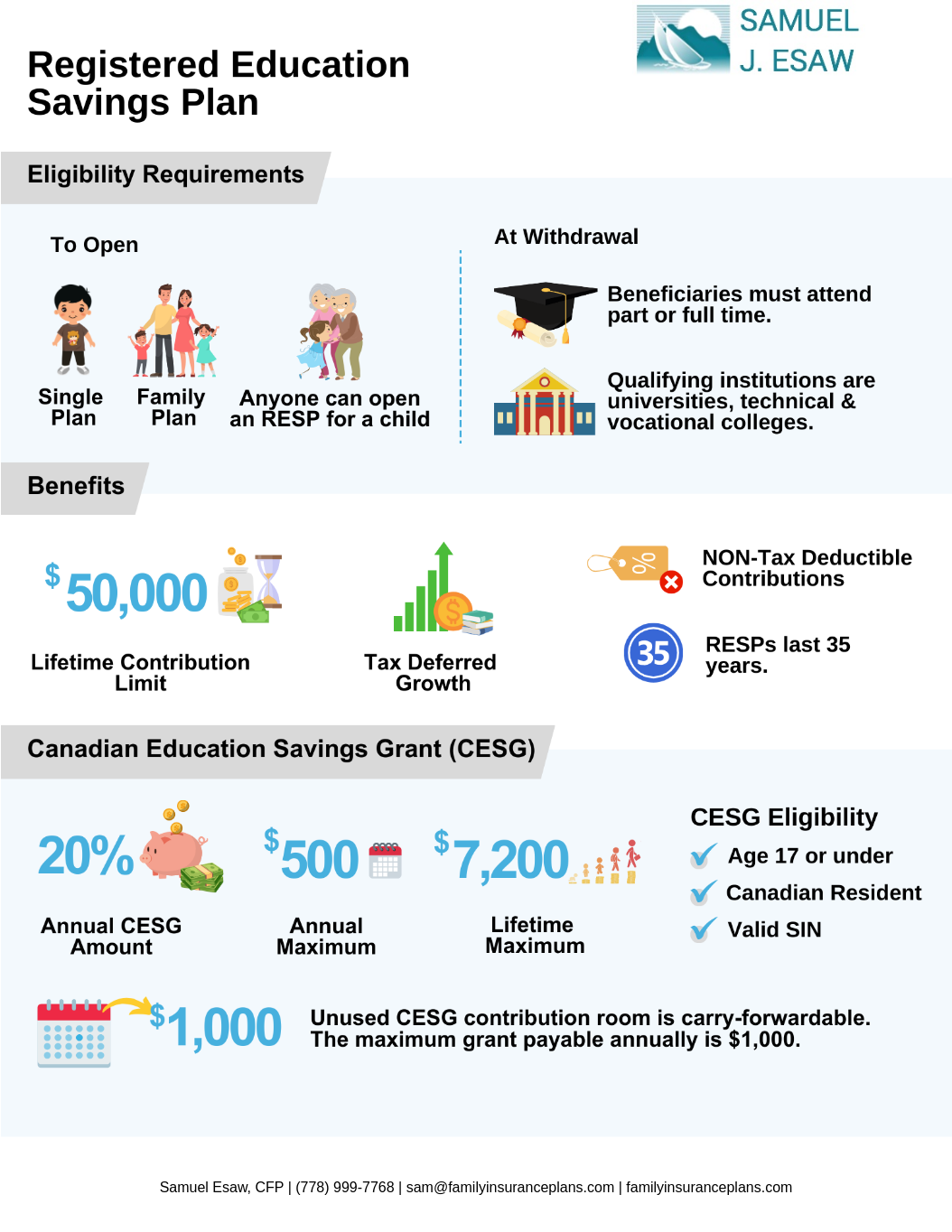
Planning for your child’s education can be both exciting and overwhelming. The rising costs of post-secondary education make it important for parents and families to consider the financial tools available to help ensure children have the opportunity to pursue their educational dreams. One such tool is the Registered Education Savings Plan (RESP), a tax-deferred savings account specifically designed to help save for a child’s post-secondary education in Canada.

Eligibility and How to Open an RESP

You can open a Single Plan for an individual beneficiary, such as your child, or a Family Plan if you wish to contribute to the education of multiple children in your family. The great news is that anyone can open an RESP for a child, whether you’re a parent, grandparent, or other family member, making it a versatile option for educational savings.

RESP Withdrawals and Beneficiary Requirements

RESPs can be used to cover a broad range of educational expenses. The only stipulation is that the beneficiary must attend a qualifying educational institution, which could be a university, college, or technical or vocational school. Withdrawals from the RESP will help support tuition, textbooks, living expenses, and more, as long as the student is enrolled part-time or full-time.

Key Benefits of an RESP

RESPs come with a range of benefits that make them an attractive savings vehicle for education:

– Lifetime Contribution Limit: You can contribute up to $50,000 over the lifetime of the plan for each beneficiary.

– Tax-Deferred Growth: While contributions to an RESP are not tax-deductible, the investment growth within the plan is tax-deferred. This allows your savings to grow faster, as taxes on the earnings are deferred until the funds are withdrawn.

– RESP Duration: You can keep the plan open for up to 35 years, giving you ample flexibility for when the funds may be needed.

Canadian Education Savings Grant (CESG)

One of the biggest incentives for opening an RESP is the Canadian Education Savings Grant (CESG). Through this program, the government will match 20% of your annual contributions, up to a maximum of $500 per year. Over time, this can accumulate to a lifetime maximum of $7,200 in CESG funds for each child. If you’re unable to contribute the maximum amount in a given year, the unused CESG contribution room is carry-forwardable, and you may be able to receive up to $1,000 in grant payments annually in future years.

Eligibility for CESG

To qualify for the CESG, the beneficiary must be:

– 17 years of age or younger

– A Canadian resident

– In possession of a valid Social Insurance Number (SIN)

A Smart Way to Save for the Future

Starting an RESP early can make a significant difference in how much you can save for your child’s education. With contributions that grow tax-deferred, along with generous government grants like the CESG, the RESP is a valuable tool to help ease the financial burden of post-secondary education. Planning for your child’s future today ensures that when the time comes, they can focus on their studies without worrying about the costs.

Consider opening an RESP to take advantage of the substantial benefits and opportunities this plan offers. Start investing in your child’s future today!

What is disability insurance?


If you cannot work because you are seriously injured or ill, disability insurance will provide you with a monthly, tax-free income to help replace your lost wages.  An injury does not have to be as blatant as a broken leg or arm – suffering from chronic pain or dealing with mental health issues can also qualify you for a disability insurance payout.

Why do I need disability insurance?

Unfortunately, people become disabled – whether temporarily or permanently – quite often. In 2017, over 20 percent of Canadians had one or more disabilities.

If you’re disabled, you may lose one of your most valuable assets – your ability to work and bring in a paycheck. Disability insurance can help replace that paycheck for as long as you need it to. Being able to rely on a disability insurance payout means you won’t have to dip into your savings if anything happens to you.

Disability insurance is especially important if you are self-employed, particularly if you are the family’s sole income earner.

What if I already have disability insurance through work?

If you have disability insurance through work, that’s great – but it may not replace 100 percent of your paycheck, especially if you’re off work for a long time. If you purchase private disability insurance, you can:

  • Choose how much coverage you want.
  • Adjust your coverage as needed.
  • Not have to worry if you leave your employer – you won’t lose your disability insurance coverage.

Having private disability insurance will give you peace of mind that you either have additional coverage if you are employed and at least some disability coverage if you lose your job.

How does disability insurance work?

We’d be happy to answer any questions you have about disability insurance. There are five main steps to disability insurance:

  1. Determine the amount of coverage you want. The higher your salary, the more coverage you should get.
  2. Pay your monthly premiums. Factors like your health, your age, and the amount of coverage you have will all impact the cost of your premiums.
  3. File a claim if you become disabled – we can help you with this.
  4. Receive your monthly payments once your waiting period has passed – a longer waiting period can lower your premiums, but it does mean you’ll go longer without any income.
  5. When you are healthy enough to return to work, or your coverage period runs out, you will stop receiving disability insurance payments.

We’re Here To Help

If you’d like to know more about disability insurance – from how much it would cost you to what you can file a claim for – we’re here to help! Give us a call today.


Getting Ready for Money Emergencies

brandableContent

Life can throw unexpected events your way that can hit you in the wallet. Whether it’s falling ill, getting laid off, or facing hefty repair bills for your car or home, these situations can strain your finances. To stay ahead and avoid falling into debt, it’s a good idea to have an emergency fund. This is cash you set aside specifically to handle unforeseen expenses, so you’re not left scrambling for money when the unexpected happens.

Why Emergency Funds Matter

An emergency fund is like an insurance policy for unexpected expenses that everyone can benefit from. It’s a stash of money specifically saved to cover daily living costs during emergencies that catch you off guard, such as:

  • Sudden car repairs

  • Vet visits

  • Losing your job

  • Sudden home repairs

  • Medical emergencies

Creating an emergency fund helps you to:

  • Deal with surprise costs without going into debt

  • Stay away from expensive loans like payday loans or credit card cash advances

  • Keep control of your finances

  • Feel less worried about unexpected expenses.

An emergency fund offers peace of mind during life’s surprises, preventing debt by covering costs without needing to use up savings or retirement funds, which could result in extra fees.

How much do you need?

The amount you should save depends on your financial situation, like how much you earn, what you spend each month, and if you have any dependents. A good rule is to have enough money to cover three to six months of necessary expenses, like rent, groceries, bills, and childcare.

How to Build Your Emergency Fund

Building an emergency fund to cover three to six months of essential living expenses might feel overwhelming, but the key is to start saving gradually. Even putting away a small amount regularly can add up significantly over time.

Here are some ways to build up your emergency fund:

  1. Automate your savings: Pick how much money you want to save, when you want to save it, and how often. Then, arrange for the money to be automatically moved from your regular account to your savings account. You can set up this automatic transfer to happen on your payday. That means the money you’ve chosen to save will be moved as soon as your paycheque is put into your account.

  2. Take advantage of opportunities to boost your emergency fund whenever you can. This might happen when you get extra money, like a tax refund, a pay raise at work, or when you sell things such as a car. Even receiving money as a gift or getting a bonus from your job can help. Additionally, when you finish paying off a loan, consider putting the money you used for payments into your emergency fund instead. Since you’re already used to budgeting for those payments, it’s an easy way to increase your savings without much extra effort.

  3. Make it a habit: Make saving a regular part of your routine by incorporating it into your daily habits. Here are some simple tips to help you get started: drop any loose change into a container whenever you come home, set up a savings, mark your saving dates in advance on your calendar, and use sticky notes on your fridge to remind yourself to save regularly. These small actions can make a big difference in building your savings over time.

Where to keep your emergency fund?

Given that emergencies can occur unexpectedly, having quick access to your funds is important. Although a regular chequing account may offer immediate access to your money, it’s best to keep your emergency fund separate from your regular account. This prevents accidental spending on non-emergencies. Look for an account that:

  • Is distinct from your regular spending account

  • Has minimal or no transaction fees

  • Permits penalty-free withdrawals

  • Earns interest on your savings

Consider exploring “cash equivalents” as an option to invest your money. They’re a bit like cash but can also help your money grow with interest. They’re safe and easy to get your money from. But before you decide, make sure you understand how and when you can take your money out and if there are any extra fees or charges. Examples of cash equivalents include:

  • Savings accounts

  • Chequing accounts

  • High-interest rate savings accounts (HISA)

  • Guaranteed Investment Certificates (GIC)

  • Money market funds

Having an emergency fund can be a lifeline during tough financial times, preventing you from falling into debt. While there’s no fixed amount you should stash away, assessing your financial situation can guide you in determining your ideal emergency fund size. If you need assistance in planning your emergency fund, don’t hesitate to reach out to us for personalized guidance and support.